
Instead of conceding the demand for a cut in personal income-tax rates, Finance Minister Nirmala Sitharaman should phase out many exemptions in both personal and corporation taxes, suggests A K Bhattacharya.

'There is no need to do anything, let your SIPs get deducted every month, and stick to your allocation between equity, fixed income and emergency funds and your risk covers.'

'Historically, equities have consistently outperformed debt, gold, property, and other assets over a reasonable period.'

The S&P BSE Midcap and the S&P BSE Smallcap indices have managed to stay afloat in a volatile January that saw the frontline indices hit their respective 52-week high levels and then slip. While the S&P BSE Sensex has lost over 2 per cent thus far in January, the S&P BSE Midcap and the S&P BSE Smallcap indices have gained nearly 2.5 per cent and 4 per cent, respectively during this period.

'When a young Indian family who had recently moved into my locality found out that I live here, the lady volunteered to send food; she said that since she was going to cook for three people anyway, she had no problem cooking for me as well.' 'Thanks to her kindness, I get one home-cooked meal every day.'

'India's fundamentals are a lot better (than those of other emerging market economies).' 'India will suffer (witness a fall in its stock market) what I call the second order effect.' 'And the second order will happen when these funds (belonging to macro and hedge fund investors and which have leveraged Japanese yen-carry trades), because they lose money elsewhere as lot of their positions were financed by borrowing Japanese yen, will have to book profits in investment destinations where they are making money, including in markets like India.' 'They (these investors) will have to effectively sell in countries like India and which is the consequence (the crash in equity markets) that Indian markets might see.'

'What do the moves towards protectionism suggest?' 'That we do not have Aatmavishwas.' 'If you have self-confidence, confidence in your ability to compete with the best in the world, why do you need protectionism?'

Foreign Portfolio Investors (FPIs) have pulled out over Rs 10,000 crore from Indian equities in the first three weeks of September, primarily due to rising US interest rates, recessionary fears, and overvalued domestic stocks. Before the outflow, FPIs were incessantly buying Indian equities in the last six months from March to August and brought in Rs 1.74 lakh crore during the period. Mayank Mehra, smallcase, manager and principal partner at Craving Alpha,believes that strong economic growth prospects, attractive valuations, and government reforms could support foreign investment flows in the next month.

India's inclusion in JP Morgan's bond index can channel billions of dollars into India. How will the government securities market handle it?

Average housing prices have increased in the range of 13-33 per cent in the last three years across seven major cities on high demand, according to real estate consultant Anarock. Hyderabad's Gachibowli recorded the highest 33 per cent increase in average residential prices in the past three years. In Gachibowli, the average residential prices as of October 2023-end stood at Rs 6,355 per square feet as against Rs 4,790 per square feet in October 2020.

Within three trading sessions in May, foreign portfolio investors (FPIs) have pumped in Rs 9,461 crore into Indian equities. This follows net inflows worth Rs 7,936 crore in March, and Rs 11,631 crore in April. The trend, analysts said, could continue going ahead as the US Federal Reserve may soon halt its interest rate hike cycle, which will strengthen foreign fund inflows into emerging markets, including India.

'Indian equity valuations, although not very expensive, are not cheap either.'

A flop Bharat Jodo Yatra could unleash more resignations from a party which under its current leadership is dying a slow death, warns Virendra Kapoor.

'Chasing sectors which have reported strongest earnings is not always the right strategy for outperformance.'

Hamsini Karthik reveals why the ongoing business rejig will help unlock value for shareholders of Grasim, Reliance Capital and Tube Investments

The finance minister could well be on her way to setting a record of achieving the biggest single-year reduction in the government's fiscal deficit, explains A K Bhattacharya.

'Geopolitical risks and their impact on oil prices, if any, are another concern for global markets, particularly for India.'

'Let us hope that this Budget delivers.' 'It needs 10 per cent plus real GDP growth in 2021-22, the rebound year,' notes Omkar Goswami.

'In difficult times as now, the call of the village is all that these migrants can hear,' observes Vijaya Pushkarna.

'The potential headwind is that the Indian economy is likely to see a slowdown in growth rates over the next two years.'

'A soft landing of the Indian economy would be a long-term positive for the equity markets.'

The seven Indian-Americans are cybersecurity firm ZScaler CEO Jay Chaudhry, founder and chairman of Symphony Technology Group Romesh Wadhwani, cofounder and CEO of online home goods retailer Wayfair Niraj Shah, Silicon Valley venture capital firm Khosla Ventures founder Vinod Khosla, managing partner of Sherpalo Ventures Kavitark Ram Shriram, Airline veteran Rakesh Gangwal and Workday CEO and co-founder Aneel Bhusri.

The navy wants to spend Rs 40,000 crore on INS Vishal, a choice the army and air force oppose. This is as much about turf as about funding. explains Ajai Shukla.

'This pandemic has given him a new platform to perform,' says a member of the government. 'He should feel lucky that he has got an opportunity now to demonstrate to the world his original talent.' 'He needs a visionary script to perform.' Sheela Bhatt reports on the politics of the pandemic.

Just because India has outperformed the US markets in a short recent period, it does not mean that this is based on fundamental reasons that are here to stay, points out Debashis Basu.
Covid-19, US yields, dollar to weigh on equity flows in the near term.

'Now is the time for India to course correct and for the government also to course correct,' says businessman Mangesh Khatri.

Indian equity markets have a limited upside potential in the near-term as they negotiate the ensuing cyclical slowdown, wrote analysts at Nomura in a recent coauthored report led by Saion Mukherjee, their managing director and head of equity research for India. He, however, believes that the foundations are in place for sustainable growth over the medium-to-long term, and hence suggests a 'buy on dips' strategy to equity investors. As an investment strategy, Nomura prefers domestic-oriented sectors and companies over exporters, and prefers stocks that provide valuation comfort. Industrials and banks are their overweight sectors, while IT services and consumer discretionary are their underweight sectors.
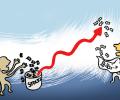
So far in 2019, India has been one of the highest recipients of foreign flows among Asian and Emerging Market (EM) economies

'Howdy Modi is an unforgettable celebration of the crowning of Modi as a world statesman,' says B S Raghavan, the distinguished civil servant.

'The economy has to become the government's No. 1 priority, which it is not at the moment,' says T N Ninan.

"In a year dominated by political chaos and bluster, it was a rare brand of steady -- even quiet -- leadership that won the day in the business world. And no one epitomises that brand of obsessively results-driven, team-based leadership more than our new No. 1 Businessperson of the Year," Fortune said.

The last edition of the 14-year-old morninger, which had already stopped from Delhi and other centres earlier, will come out on Thursday from Mumbai and Ahmedabad, the broadsheet owned by Zee group's Subhash Chandra's Essel group said.

They are both electronic manufacturing services (EMS) companies, also known as contract manufacturers. One is Taiwan's Foxconn group, the undisputed global number one in this business with revenues of $223 billion. The other is Dixon Technologies, the biggest domestic player with revenues of over Rs 10,500 crore.

A strengthening dollar, rising interest rates, tightening liquidity and a surge in oil prices - all are combining to create a toxic atmosphere for EM assets, says Akash Prakash.

The total quantum of water supply has barely improved since Independence, while demand has exploded, points out T N Ninan.

Investing in the US market provides Indian investors a hedge against the rupee's long-term tendency to depreciate against the dollar.

Parasite's razor-sharp characterisations ensure that the picture is thoroughly entertaining though it falls short of greatness, declares Sreehari Nair.

'What is holding this government to ransom is the Parivar. It is this group's thought process, ideals and philosophies that course through the veins of India's elected government. And it is this that is holding the government, and through it the country, to ransom.'

In his latest book, Fly Me To The Moon, former member of Parliament Prafull Goradia provides interesting insights into the man who is India's prime minister.
